
How to summarize a court judgment with AI: a checked case brief
Build a case brief you can check against the original judgment. Use a structured prompt, a source map and a review checklist before relying on the summary.
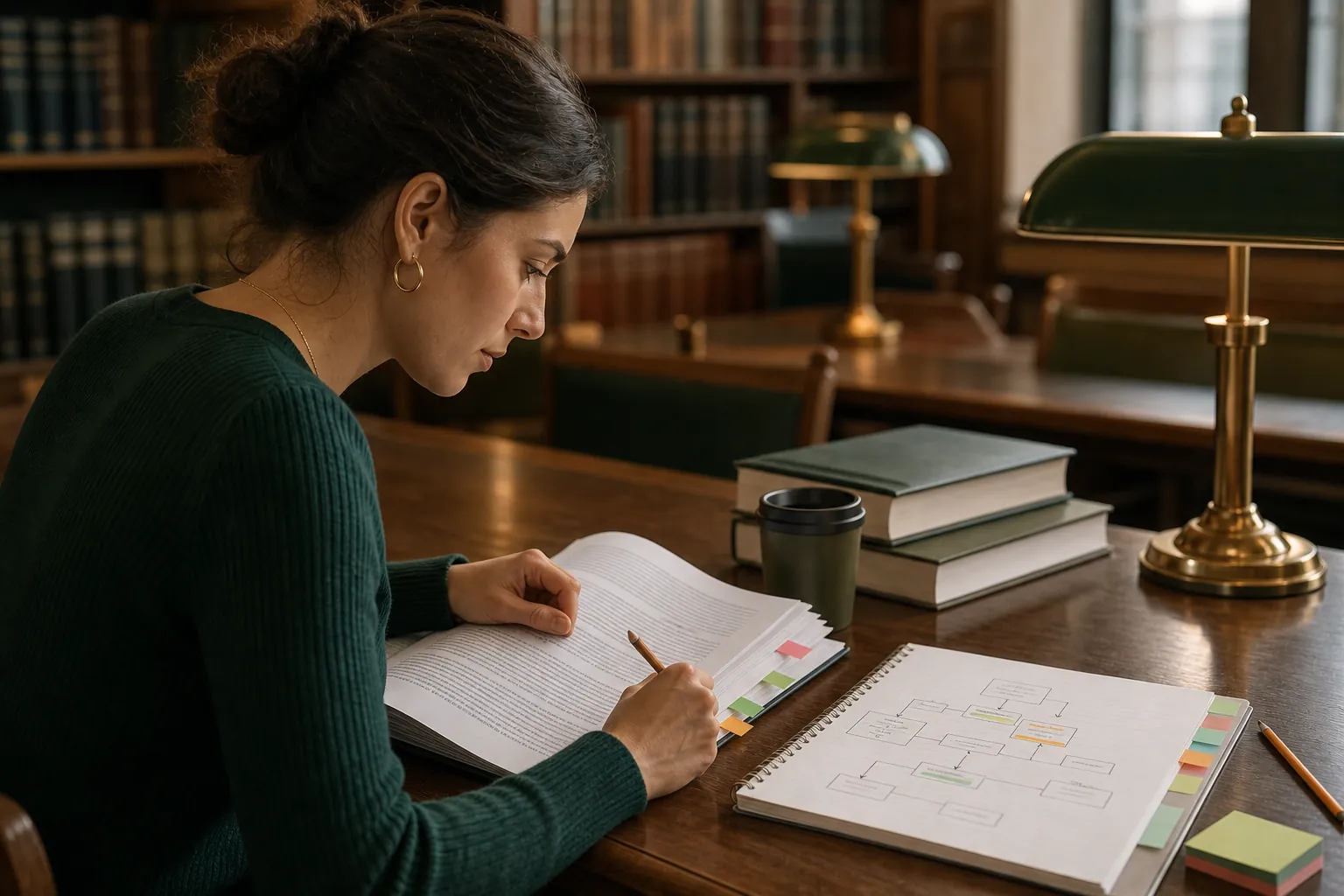
An AI case brief should help you find your way through a court judgment, rather than replace the judgment. The useful output is a structured working note with a traceable source for each important point. A polished paragraph is a poor shortcut if it confuses a party’s submission with the court’s own conclusion.
The workflow below is for reading and study. It does not establish whether a decision controls your case or tell you when to appeal. Start with a public document you are permitted to use, and check confidentiality requirements before uploading anything that contains private information.
Check the judgment and the text you provide
Keep the complete document, its original link and the date you accessed it. Check the court, decision date and case reference. Retain an ECLI if one is supplied: the European e-Justice Portal explains this identifier, which is useful for locating relevant European decisions. It is not an identifier used by every court worldwide.
For a scanned PDF, inspect the extracted text before asking for a summary. Missing negatives, broken paragraph numbers or omitted pages can change the result. Record any missing appendix, separate opinion or section instead of allowing the assistant to guess what it says.
Use a seven-part case brief template
Create seven fields: case identification; material facts; procedural history; issue; reasoning; decision or disposition; unresolved questions and limits. For every field, add a page, paragraph or section reference that lets you return to the original.
Keep the parties’ arguments separate from findings and the court’s analysis. A passage quoting an earlier case is not necessarily the current court’s final position. Preserve what was actually decided and identify the stage of the proceedings. Follow your course or workplace’s preferred briefing format where it differs from this working template.
A prompt for a source-linked AI summary
Try this instruction: “Use only the judgment I supply. Prepare a case brief with identification, material facts, procedural history, issue, reasoning, disposition and unanswered questions. Attach a paragraph, page or section reference to each field. Distinguish submissions from findings and conclusions. If a detail is absent, write ‘not stated in the supplied text’. Do not invent authorities, quotations or later proceedings.”
Then ask for a review list: “Identify statements in your brief that depend on an exact quotation, a number or an interpretation. Tell me where I should check each one in the original.” Treat that list as another aid to your own review, rather than proof that all errors have been found.
Check five things before using the brief
First, verify that the case reference and court match the document you intended to read. Second, compare the disposition with the full closing order or decision. Third, open every reference supporting a material claim. Fourth, check dates, numbers, qualifications and negatives. Fifth, mark omissions or conclusions that lack clear support.
The judiciary of England and Wales warns about misleading AI output and confidentiality in its guidance for judicial office holders. That document has a specific institutional scope. The practical lesson for this reading exercise is to verify the output and avoid supplying information you should not share; the guidance is not a universal rule for every reader or jurisdiction.
Turn the brief into a study exercise
Without looking at the AI output, explain the issue and the court’s reasoning in a few sentences. Reopen the judgment to identify what you missed. Create questions about the decisive facts, the argument the court rejected and the limits of the decision. This gives you a way to test understanding instead of collecting summaries you have not read.
Legal Assistant AI offers document analysis and law-study tools. You can use it to organise an initial brief and ask follow-up questions while keeping the source available. A checked summary still does not replace advice on a live matter: deadlines, available remedies and the weight of a decision depend on the relevant jurisdiction and circumstances.